

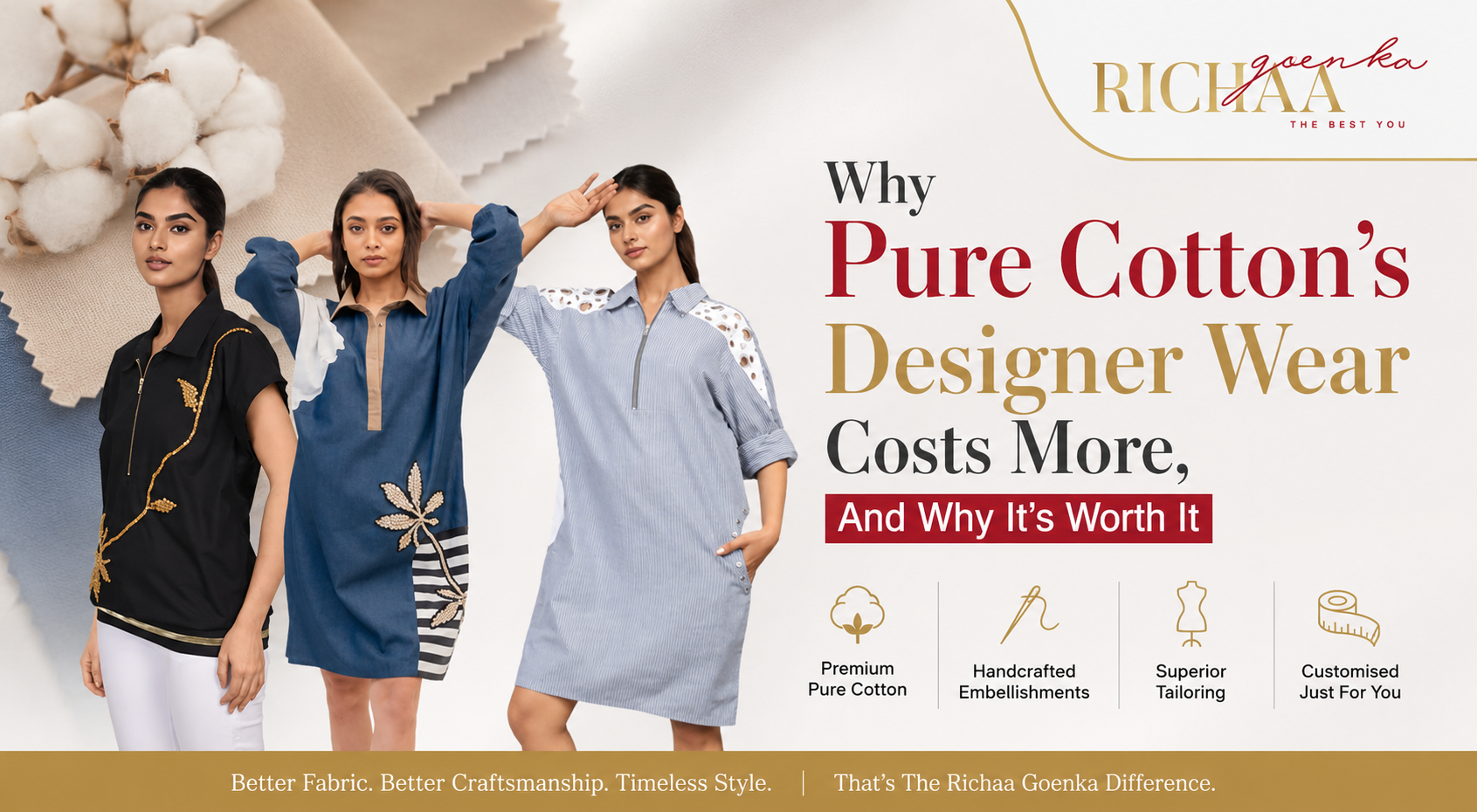
Why Pure Cotton's Designer Wear Costs More, And Why It's Worth It
It is a fair question, and one that comes up often. Cotton, after all, is one of the most widely available fabrics in the world, you can find a cotton t-shirt for a few hundred rupees at almost any store. So why does a pure cotton designer shirt or dress cost several thousand rupees more?
The honest answer is that not all cotton is the same, and not all cotton garments involve the same amount of work. Once you understand what actually goes into a piece of designer cotton clothing, the price difference starts to make complete sense.
Not All Cotton is Created Equal
The first thing to understand is that cotton, as a raw material, varies enormously in quality. Fibre length, weave density, and the way the fabric is finished all affect how a cotton garment looks, feels, and performs over time.
Mass-produced cotton clothing typically uses shorter fibres and looser weaves to keep production costs low. This is why inexpensive cotton garments often feel thin, lose shape quickly, or develop a rough texture after a few washes. Premium pure cotton, by contrast, is selected specifically for its strength, softness, and ability to hold both colour and embellishment without losing its drape. This selection process happens before a single stitch is made, and it is the first real cost difference between a basic cotton top and genuine women's designer clothing.
The Real Cost is in the Handwork
Fabric quality explains part of the price gap. The larger part comes from what happens to that fabric after it is cut.
A piece of designer cotton clothing is rarely just sewn together. It is embellished, often entirely by hand. Sequin work, stone detailing, threadwork, and appliqué are time-intensive crafts, with a single garment sometimes requiring several hours or even days of skilled embroidery work. This is the defining difference between a plain cotton shirt and an embroidered designer shirt for women: the embroidery is not printed or machine-applied at scale, it is built into the fabric stitch by stitch.
This handcraft also explains why no two heavily embroidered pieces are ever entirely identical. A slight variation in motif placement or thread tension is not a flaw, it is proof that a human hand, not a machine, created the piece.
Construction and Tailoring Add Another Layer
Beyond fabric and embroidery, the way a garment is constructed plays a significant role in its final cost. Designer pieces typically involve more fabric panels, more precise cutting, and considerably more finishing work than mass-market clothing.
This becomes especially clear in structured pieces like a luxury designer dress for women, where draping, lining, and silhouette shaping require far more skill than a simple straight-cut garment. The same applies to coordinated pieces, a well-fitted women's designer co-ord set requires both pieces to be cut and tailored to work together proportionally, which adds a layer of precision that off-the-rack basics rarely require.
Customization Changes the Economics Entirely
Most affordable clothing is made in bulk, in standard sizes, using the same pattern repeated hundreds of times. Designer cotton clothing, particularly when customization is involved, works in the opposite direction.
When a garment is tailored to an individual's measurements, adjusting sleeve length, fit, or design details, it stops being a mass-produced product and becomes a one-off creation. This is true for an Indo Western designer dress for women built around a customer's preferred silhouette, just as it is true for a simple top adjusted to fit a particular body shape. Made-to-measure work takes longer, requires more skilled labour, and cannot be scaled the way factory production can, and that is directly reflected in the price.
Why It's Worth Paying More
When you put fabric quality, hand embroidery, precise tailoring, and customization together, the higher price of designer cotton clothing stops looking like a markup and starts looking like an accurate reflection of the work involved.
There is also a longer-term value to consider. A well-made cotton garment, properly cared for, holds its shape, colour, and embroidery for years, unlike inexpensive cotton clothing that often needs replacing within a single season. A designer cotton embroidered top for women, worn occasionally and cared for properly, can realistically remain part of a wardrobe for many years, which changes the actual cost-per-wear far more favourably than the upfront price suggests.
About Richaa Goenka: Where the Cost of Craft Is Visible in Every Piece
Richaa Goenka is a Chennai-based premium designer label built entirely around this philosophy, that genuine craftsmanship costs more because it deserves to. Every piece in the collection begins with hand-selected pure cotton, alongside crepe, satin, and organza, chosen specifically for how each fabric performs and how well it holds intricate handwork.
From there, skilled Indian artisans take over, applying sequin work, stone embellishments, threadwork, and appliqué entirely by hand. Each garment is also available for personalized customization, allowing fit, silhouette, and design details to be adjusted to the individual wearing it.
This commitment to craft has earned Richaa Goenka recognition far beyond India, including a permanent place in the Osaka Museum's collection and runway showcases from Chennai to London. It is also the reason the label has been chosen by celebrities including Mouni Roy, Divyanka Tripathi, Sunny Leone, and Trisha Krishnan, not for marketing, but for the quality that is felt the moment a piece is worn.
For Indian women who want clothing that justifies its price through real craftsmanship rather than a label, Richaa Goenka offers exactly that.